May 17th, 2010

Plant Sale on KSTP

On Friday during the sale, we were visited by a KSTP Channel 5 cameraman. Here’s the result of his work.

Yes, that really is me in what I call my “Plant Sale regalia.” Wearing wool under the t-shirt, and hoarse from laryngitis.

May 10th, 2010

The 2010 Sale Is History!

Well, we sold every single plant by the end of Sunday!

Thanks to everyone who came and shopped, and especially to our incredible volunteers who made it all happen.

The checkout line got pretty long on Sunday, but it kept moving and I believe (from what I’ve heard so far) was generally no more than 20 minutes to reach the tallyers.

We’ll be working on ideas for next year, so if you have suggestions, send them to info@friendsschoolplantsale.com.

May 9th, 2010

Half Price Sunday!

Everything left at the Friends School Plant Sale is half price today! I walked through the whole sale last night (oops, I have to admit I didn’t check the Rare Plants booth) and I’d say there are substantial quantities of many of the varieties we originally listed in all areas.

There are nearly 200 hanging baskets left.

In herbs, there is basil left but I have to say that at least some of it appears to be cold-damaged, even though it is indoors. (The outside cold comes into the unheated building.) But other herbs are still good-looking and available (gee, that sounds like a dating service).

Vegetables — and especially seeds for some of the varieties — are in pretty good supply. (Yellow wax beans, anyone?)

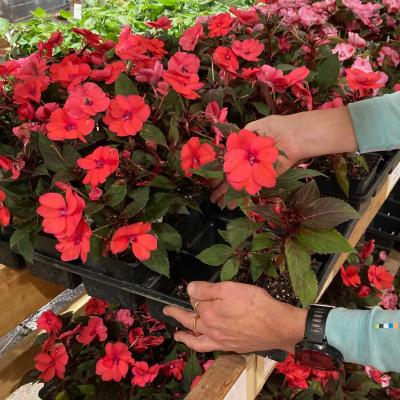
Lots of annuals. We think impatiens must be waning in popularity because that stock is particularly high. And no one seemed to want to try the large oleander tropicals in the back of the annuals — I think only a few sold.

Perennials offer a wide selection. Not too many hostas, but generally a wide assortment of other plants.

Although I made no attempt to count them, I’d say we’re well stocked with lily bulbs and daylily roots as well. (No asparagus, though!)

There aren’t a lot of clematis left, although there are some in the climbers.

Outside, there are quite a number of native wild flowers and grasses left. Roses as well.

The fruit is also fairly well stocked — particularly apricots and peaches.

Shrubs are more spotty — some have stock while others are gone. (Of course, that’s true throughout the sale but the larger spaces in the shrubs make it more obvious.)

Like all half-price sales, this one gets a bit nutty, but there are definitely deals to be had!

May 8th, 2010

Friday Plant Sale Report

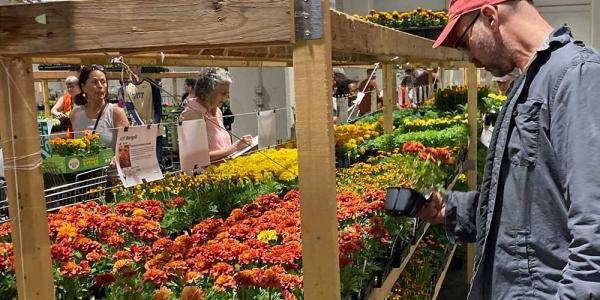
The morning line was a bit slower than usual to build up, on account of the rain. But by opening there were over a thousand hardy souls outside with umbrellas and carts of all types.

It rained steadily throughout the day, to everyone’s misery. (The plants that are outside were happy, though.)

As usually happens, about an hour to an hour and a half after opening, many of the people who came in at the same time at the opening started to check out and the checkout line built up. We apologize to EVERYONE at the sale at that time, because we (for the first time since we moved to Grandstand five years ago) lost control of the waiting line, which snakes around the building.

We know that many folks had to wait what we consider a very unreasonable time to reach the checkouts. (We normally can honestly say the wait at busy times is between 10 and 20 minutes max, but this was clearly not the case for about an hour yesterday.)

We have already addressed the issue for Saturday and Sunday this year, and will (as soon as the sale is over) discuss better systems for it in 2011.

By 3:00 p.m., however, things in the sale were busy but pleasant and the wait was down to no more than five minutes.

P.S. The Plant Sale (and I) were on KSTP Channel 5 news last night. They had some nice footage of what the sale looks like! I’m trying to see if I can get it made into a YouTube video to post to our website.

May 7th, 2010
May 7th, 2010

Friends School Students Rock!

A brief moment of rest for these middle school students, who cheerfully spent days unloading trucks, organizing plants, and generally getting things ready for the sale to open.

friends school kids at sale

May 6th, 2010

Updated Crop Failure List

Up until Thursday we were doing our best to keep the crop failure list up to date. Unfortunately, I have to say that at this point the list is substantially larger than what is shown here but I don’t have the time to get it posted (have to sleep to return to the sale tomorrow!). Find the incomplete list here.

May 6th, 2010

Firethorn

Solanum pyracanthum (AKA Porcupine Tomato)

I know that there are other gardeners who like out-of-the-ordinary plants as much as I do, but I admit that this prickly monster is a stretch. At last year’s sale I bought eight tiny Firethorn plants and thoroughly enjoyed having them in my garden. Every child who saw them was enchanted and every grown-up had to ask what the heck they were. I was surprised at how well Firethorn mingled with other plants and at what a lovely orange mist they created with the sun shining through them. Firethorn looks especially nice with orange Zinnias and Nasturtiums, and with purple Sea Holly.

firethorn closeup

firethorn in a garden

Yikes! Wicked, scary, and bizarre. Half-inch decorative orange thorns line the orange veins on both tops and undersides of the long, deeply lobed blue-green leaves. More thorns on the orange fuzzy stems. Star-shaped 1” lavender flowers in summer are just the plant’s futile attempt to look cute. Fiercely beautiful in combination with orange flowers and copper foliage.

48″ wide and 36” tall sun

May 6th, 2010

Spring Into Action - Backyard Spring Rolls

I was making spring rolls the other night and thought, wow, I could actually purchase all of the produce necessary for spring rolls this year from the Friends School Plant sale and grow it in my backyard! To decide that you are going to make spring rolls and then gather all of the fresh ingredients from your back yard is such an amazing feeling. Though I have never tried growing ALL of the fresh ingredients for spring rolls in my backyard before, I’m going to try it this year. Join me in my experiment!

spring roll picture

Here’s the shopping list of plants you are going to need or should consider:

Garlic Chives - Some people say this is optional, but it enhances the flavor of spring rolls so much, that I would say it is a definite yes in a spring roll. Great for other Asian style dishes also. If you don’t like the garlicky bite you will get from it, than skip it.
Vietnamese Coridander - A must herb for some people in spring rolls.
Garlic - Important for the dipping sauce.
Mint - choose Spearmint or Peppermint - This is a must herb for most people in spring rolls.
Red Shiso - This is a must herb for most people in spring rolls, though I spent years of my life refusing to have it in my spring rolls. Only as I have gotten older do I know appreciate the taste and love it in my rolls. Don’t be like me and wait years to find out what a great herb you are missing out on. This might be a more advanced herb in terms of taste, but it is definitely worth trying it.
Cucumbers - Burpless, Tasty Jade (new this year) - Any cucumber will do, but I would recommend a burpless variety. It works better for spring rolls. Tasty Jade is a burpless variety.
Lettuce -Bibb, red leaf (Red Sails), green leaf (Grand Rapids) - Any of these varieties should be great though I have not grown any of these varieties before.
Mesclun - When you want to mix it up a little bit and try something other than the lettuce.
Thai Dragon - or a pepper of some type is needed for the sauce if you like it spicy.

With all of the produce grown in the yard, you’ll only need to get noodles, rice paper and the meat/protein of your choice at the supermarket.

I will post the spring roll recipe with instructions as the summer progresses when the produce is ready for picking! Or if you have to know now, I will be at the Brandy Tang booth at the plant sale. Stop by and I’ll tell you want to do for spring rolls.

May 5th, 2010

Cook With Chicken, Makes Body Strong

Hmong woman with hat, working in a greenhouseWhile visiting one of the local greenhouses that supply the Friends School Plant Sale, Henry found a plant he had never seen before. But when he showed it to the head grower, she said, “Oh, those are Song’s plants.”

Luckily for Henry, Song is the only Hmong employee at the greenhouse who speaks English.

She called the plant “cook with chicken, makes body strong.” She said in white Hmong the name translates to “duck foot.” It looks a little like celery and has a pleasant taste and aroma. It’s is used in dishes such as spicy wedding chicken and a chicken stew made for women who have just given birth.

Song said it’s a perennial, but only likely to survive our winters with heroic protection. She got it from her sister in California.

Knowing that the Friends School Plant Sale was in the midst of expanding our offering of herbs and vegetables from Asian and other world cooking traditions, Henry tried to find out more.

But he found that there’s very little info about Hmong plants available, including at libraries. He visited the Hmong ABC bookstore on University Avenue, where a helpful young man assured it was indeed “cook with chicken, makes body strong,” but he knew no more about it than that. He said to ask an elder, saying, “Any elder would know.”

Henry went to the Hmong library and cultural center where the librarian introduced him to a roomful of elders. They all agreed the plant was “cook with…,” and Henry learned it is not actually one plant at all, but several that are combined and cooked together with chicken. He also found out that Hmong writing cannot be sounded out using American phonetics.

The plant Henry had first seen is called: ko taw qos liab.The newly released Cooking from the Heart: The Hmong Kitchen in America calls this koj liab. “Liab” is pronounced like the name “Leah,” and it means red. The Hmong have one word for red and it covers all the reddish hues including pink and purple. The plant has purple stems.

Green leaves of the herb ko taw qos liab
Ko taw qos liab

A second herb that Song said fit into the same “common” name was chuaj rog (tshuaj rog in the Hmong cookbook). Henry couldn’t figure out how to write it phonetically. The first word is pronounced choo (not like a train but with the oo from hook), while the second starts with a “t” sound but does not rhyme with dog. This name means “fat medicine” in English (because it’s used to improve appetite). It comes in three different colors, green, red and white.

Green leaves with red stems of the Hmong herb chuaj rog
chuaj rog

In addition to the plants from Song, we also found out about a few of the other herbs that are part of the Cook with Chicken, Makes Body Strong medley, and will have them at the sale:

ntiv — also called sweet fern (not the same as the North American native sweetfern).

licorice flag, Acorus gramineus, whose Hmong name is pawj qaib (pronounced pakai)

All of these plants can be found in the Herbs at H036. We assume they would like full sun for best growth. Their heights are a bit unknown to us.

(According to Cooking from the Heart, another herb that is traditionally used as part of Cook with Chicken, Makes Body Strong is one of our local “weeds,” the common day flower. We won’t have that at the sale, but you may have it growing in your yard!)